


MOST LIKELY QUESTIONS: HISTORY OF GHANA(END OF SEM, COHORTS I AND II WITH SCHEMES)
MOST LIKELY QUESTIONS: HISTORY OF GHANA FROM ANCIENT TIMES TO THE PRESENT

ESSAY QUESTIONS WITH ANSWERSCOHORT I MARKING SCHEME
HISTORY OF GHANA –EBS 412 SW.
END OF SEMESTER EXAMINATION QUESTIONS
Attempt all questions by circling in ink the correct answers from the alternatives A-D.
1. The 1925 Guggisberg’s constitution is considered very significant because of the following except…….
A. Africans were excluded from the Executive Council
B. It increased the membership of the Legislature
C. It introduced the elective principles into Gold Coast
D. It promoted decentralisation in the colonial administration
2. The foundation of United Gold Coast Convention (UGCC) in 4th August 1947 was led by which of the following persons?
A. Dr. J.B. Danquah
B. Edward Akuffo-Addo
C. Emmanuel Obetsebi-Lamptey
D. George Alfred Grant
3. The year 1948 is special in Ghana’s political history because of this reason. Which is it?
A. It created greater political awareness among Gold Coasters
B. It ended colonial rule in the Gold Coast
C. It gave economic freedom to Gold Coasters
D. It made Gold Coast popular in Africa
4. One of these African scholars inspired Dr. Kwame Nkrumah to increase his anti-colonialism agenda. Who was he?
A. George Fraisah
B. Nelson Mandella
C. Sir Gernant Worsley
D. W. E. B. Du Bois
5. Which Act gave the Minister of Interior during Nkrumah’s regime the right to determine who was a citizen of Ghana?
A. The Deportation Act of 1957
B. The Ghana Nationality Act of 1957
C. The Presidential Election Act of 1965
D. The Preventive Detention Act of 1958
6. What was the main reason for instituting the Deportation Act of 1957?
A. To drive away the Europeans who owned most of the economic activities
B. To expel aliens who were anti-CPP from Ghana
C. To know the real Ghanaians at the time
D. To know the total population of Ghanaians at the time
7. What was the most significant effect of the Preventive Detention Act (PDA) of July 1958?
A. It crippled the activities of other political parties
B. It enabled the ruling party to sentence its critics without trial
C. It ensured political stability of Ghana for some time
D. It made Nkrumah more powerful
8. In which year was Ghana declared a one party state?
A. March 6, 1957
B. July 1, 1960
C. February 21, 1964
D. February 21, 1965
9. The major aim for passing the Avoidance of Discrimination Act in December, 1957 was to……
A. Consolidate Ghana’s independence
B. Stifle organisations, parties and societies organised on ethnic, regional, racial and religious lines
C. To make CPP the only recognised political party
D. To promote nation building
10. What was the purpose for establishing the Cocoa Purchasing Company in 1962?
A. To break the monopoly enjoyed by foreign companies
B. To encourage cocoa farmers to grow more crops
C. To monitor the cutting down of the cocoa trees affected by swollen shoot disease
D. To pay compensation to farmers whose cocoa trees were cut down
11. One of the following was among the objectives of which Nkrumah’s government tackled the issue of Education. Which one was it?
A. To create awareness of the need to fight for independence
B. To demonstrate to Ghanaians how much education was dear to him
C. To extend literacy to a great number of Ghanaians
D. To sell CPP’s ideologies to Ghanaian
12. In order to improve the health needs of the people, two major hospitals were built by Nkrumah. What are they?
A. Cape Coast Regional Hospital and Wassa Amenfi Hospital
B. Effia Nkwanta Hospital and Ridge Hospital
C. Korle-Bu Hospital and Okomfo Anokye Hospital
D. Okomfo Anokye Hospital and Effia Nkwanta Hospital
13. One of the following persons was among the architects of the 1966 coup that toppled Nkrumah’s government. Who was he?
A. E. K. Kotoka
B. H. A. Coffie Crabbe
C. Major J. A. Ankrah
D. Mr. E.R.T Madjitey
14. The overthrow of Nkrumah was very much engineered by which of the following factors?
A. Deep economic crises
B. Overspending as a result of economic policies
C. The authoritarian rule of Nkrumah
D. The introduction of the PDA of 1958
15. Which of these can we consider as the major political achievement of NLC?
A. The arrest of the perceived corrupt CPP leaders
B. The establishment of commission of enquiry to trial CPP leaders
C. The production of the 1969 constitution which returned the country into civilian rule
D. The replacement of PDA with Protective Custody Act
16. Under which regime was the Operation Feed Yourself policy launched?
A. Convention People’s Party
B. National Liberation Council
C. National Redemption Council
D. Supreme Military Council I
17. The removal of Busia from office in 1972 can primarily be attributed to one of the following reasons. Which one is it?
A. The Aliens Compliance Order
B. The clash with the Trades Union Congress (TUC) over higher wages
C. The Devaluation exercise of the cide in December which resulted in high inflation
D. The introduction of Apollo 568
18. Which of the policies of Acheampong gained the massive support of Ghanaians?
A. Operation Feed Your Industry policy
B. Operation Feed Yourself policy
C. Repudiation/Yentua Policy
D. Self Reliance policy
19. The introduction of the National Service Scheme in 1973 was meant to……….
A. give new graduates working experience before entering the job market
B. increase the work force of the country
C. make students serve the nation right after graduation
D. replace the cancelled students loan policy
20. What factor culminated the second palace coup during Acheampong’s regime?
A. Activities of pressure groups
B. The dictatorship governing style of Acheampong
C. The failure of the operation feed yourself policy leading to food shortage
D. The plebiscite on the union government organised in 1978
MARKING SCHEME FOR SECTION A
1. C 6. B 11. C 16. B
2. A 7. C 12. D 17. A
3. A 8. D 13. A 18. C
4. D 9. B 14. C 19. D
5. B 10. A 15. C 20. B
Note: Each question carries 1 mark each. (20x1=20)
SECTION B
1. Discuss with relevant examples five (5) achievements of Dr. Kwame Nkrumah and the CPP government
2. a) Examine the immediate causes of the 1948 riots in the Gold Coast
b) Explain four (4) effects of the 1948 riots on the independence fortunes of Ghana
3. Advance five (5) arguments to justify the need for the 1966 coup in Ghana.
4. Examine critically five (5) factors that led to the failure of Busia’s government.
5. Discuss five (5) Impacts of the Economic Recovery Programmes ERPs on the socio-economic lives of Ghanaians
MARKING SCHEME FOR SECTION B
Q1. Nkrumah’s Achievements
1. Compensation was paid in cash for every diseased cocoa tree destroyed by the government.
2. The Cocoa Purchasing Company was established in 1962 to break the monopoly enjoyed by foreign companies.
3. Schemes were also set up under which farmers were made to study modern methods of agriculture at well-established experimental farms.
4. Other innovations in agriculture during this period included the introduction of improved irrigation methods.
5. Another feature of the agrarian revolution was the organisation of regular agricultural shows.
6. Between 1957 and 1966, the government introduced programmes which could produce professionals and skilled supporting staff needed in the industrial sector of the economy.
7. The government also nationalised some industries, and made them joint-enterprises.
8. To overcome the problem of the country’s over-dependence upon foreign loans and capital equipment, the government established some institutions.
9. The Nkrumah government also passed laws to prevent foreigners from participating in some areas of industry and commerce.
10. To develop industry further, the government established some industrial enterprises
11. The Nkrumah government realised the need for a cheap source of power to encourage industrialisation. To this end, the Volta River Hydro-electric Project at Akosombo was tackled during this period completed in 1964. Commissioned on January 23, 1966, the Volta Dam began to provide cheaper power for both domestic and industrial use.
12. The same period also witnessed the introduction of the country’s own currency, the cedi.
13. Tourism was boosted. The State Hotels Corporation was established to promote hotel services. To boost the tourism industry further, the Ghana Tourist Board was established during the period.
14. The government also gave much support to the development of sports and entertainment in Ghana.
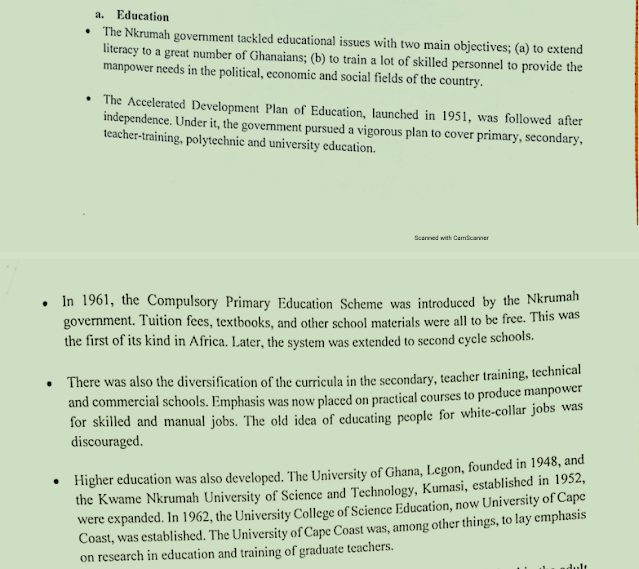
15. The Accelerated Development Plan of Education, launched in 1951, was followed after independence.
16. In 1961, the Compulsory Primary Education Scheme was introduced by the Nkrumah government. Tuition fees, textbooks, and other school materials were all to be free.
17. Higher education was also developed. The University of Ghana, Legon, founded in 1948, and the Kwame Nkrumah University of Science and Technology, Kumasi, established in 1952, were expanded. In 1962, the University College of Science Education, now University of Cape Coast, was established. The University of Cape Coast was, among other things, to lay emphasis on research in education and training of graduate teachers.
18. The Nkrumah government introduced scholarships and bursary schemes for the studies within Ghana and overseas. Some friendly countries and private organisations also supported these measures. Many Ghanaians, therefore, gained from the schemes.
19. The Okomfo Anokye Hospital in Kumasi and the Effia Nkwanta Hospitals in Sekondi were new hospitals built during the period.
20. The practice of patients paying fees for consultation and treatment in the clinics and hospitals was stopped. Ghana then became the first African country to provide free medical care for her people.
21. In order to solve the problem of inadequacy of doctors and supporting staff like nurses, the University of Ghana set up a Medical School. The Korle-Bu Hospital also began to serve as a practical training ground for the doctors. Besides, a Faculty of Pharmacy was set up by the University of Science and Technology. Other schools for nursing were established in many towns throughout the country.
22. The Ghana Housing Corporation was also established to construct modern houses and build well-planned estates.
23. Water supply and electricity were other social services that were expanded during this period. Both urban and rural areas enjoyed from the rapid expansion of water supply and electricity.
24. There was also the construction of feeder roads to link the major trunk roads. Many outlying villages were also linked to urban and commercial centres. The opening of the rural areas was a measure designed to check the frequent drift to the cities.
(Note: Candidates can also group the achievements under Political, Social, Economic, Cultural, etc. Or under Agricultural, Manufacturing, Education, Social, Cultural, etc.) Any 5 points x 4 =20marks. Statement of point=1mk. Explanation with Examples=3mks.
Q2. a) The Immediate Cause of the 1948 riot in Ghana
The Christiansborg crossroads shootings. The shootings on the orders of Superintendent Imray, a white police officer at the castle, resulted in the deaths of three ex-servicemen, namely
· Sergeant Adjetey
· Corporal Attipoe and
· Private Odartey
This sad event ignited the flame of the people’s anger against the colonial government. They spontaneously took to the streets, venting their frustration and anger at the colonial government. this shooting incident fuelled the already harboured problems which have confronted Ghanaians and ignited their anger to strike.
Explanation of the immediate cause of the riot=4mrks
b). Impact of the 1948 riots in Ghana
i. The arrest of the ‘Big Six’ turned them into instant national heroes which in turn boosted their political fortunes. They were: Kwame Nkrumah, J.B. Danquah, Obetsebi LampteyAko Adjei, Edward Akuffo Addo and William Ofori Atta
ii. The events of the 1948 disturbances created greater political awareness among Ghanaians.
iii. The 1948 riots shook the colonial government to wake up from its state of complacency and made it speed up constitutional reforms.
iv. The 1948 riots were instrumental in the setting up of the Watson Commission followed quickly by the Coussey Committee. This resulted in the 1950 Coussey Constitution (also known as the Arden Clarke constitution) which came into force on 1st January 1951.
v. The 1948 riots speeded up the process towards self – rule in Ghana.
vi. It was the 1948 riots that paved the way for the February 1951 general elections which saw the imprisoned Nkrumah and his CPP sweep the polls by winning 34 of the 38 popularly elected +seats in the Legislative Assembly.
vii. A triumphant Nkrumah rose from prison to form the first ever Ghanaian government with him occupying the position of Leader of Government Business and a year after (1952), Prime Minister.
Thus, the 1948 riots marked a turning point in the political history of Ghana. In March 1957, less than a decade after the 1948 riots, Ghana gained her independence becoming the first African nation, south of the Sahara, to do so.
Any 4 points x 4=16. (4+16=20mks). Statement=1; Explanation with Examples=3
Q3. Justification of the 1966 coup
a. The authoritarian rule of Nkrumah laid the foundation for the 1966 coup.
b. Another reason was the increase in the personal power of Nkrumah. Subversive activities of the opposition compelled him to subdue most agencies of the state. By the use of the Preventive Detention Act (PDA) of 1958, some CPP members terrorised and victimised people. For this reason, the military were fed up with Nkrumah and his regime.
c. Again, as more unqualified persons were put into responsible positions, bribery and corruption became rampant. Many people, particularly CPP officials, acquired wealth and lived in luxury at the expense of the ordinary people. An example was Krobo Edusei, a Cabinet minister who was known to have imported a golden bed from London for his wife.
d. Also, the attempt at achieving economic and social revolution within a short time resulted in rushed planning and overspending. The award of contracts and purchases went into wrong hands and prices were often inflated. This ended up in heavy external borrowing and internal taxation. The ordinary people who bore the burden of the economic dislocation became dissatisfied. This gave rise to agitations which ended up in the organisation of the coup.
e. Moreover, members of the Ghana army had their grievances. The establishment of the Presidential Guard, known as the President’s Own Regiment (POR), tended to create dissatisfaction among the regular army. Nkrumah gave preferential treatment to his growing bodyguard and intelligence corps. This was also revealed by the coup leaders later.
f. Besides, the dismissal of the Chief of Defence Staff and the Army Commander by Nkrumah in 1965 without any official reasons helped to create tension and suspicion within the ranks of the forces.
g. Another factor for the 1966 coup was the economic crisis which the country was plunged into before February, 1966. The reserve of £220 million which the British bequeathed to Nkrumah at the time of independence had all been spent within eight years. By 1966, therefore, there was economic distress as prices of commodities had risen tremendously.
h. The socialist and Nkrumahist policies, and the attempt of Nkrumah at creating a Continental Union Government for Africa invited more external enemies for him. No doubt, then, that it was widely believed that the American Central Intelligence Agency (CIA) master-minded the 1966 coup.
Any 5points x 4=20mks. Statement=1; Explanation with examples=3
Q4. Factors that led to the failure of Busia’s government
i. The introduction of the Aliens Compliance Order. Under the Order, therefore, immigrants without residence permit were asked to leave the country. But the order was enforced in an inhuman way. This caused a great deal of hardship to the immigrants. It offended neighbouring countries like Togo, Nigeria, Burkina Faso and Mali whose national were mainly affected. It finally helped to make Busia unpopular at home and abroad.
ii. This introduction of the “Apollo 568” also caused the fall of the Second Republic government under Busia. Under it, about 568 senior and junior public servants had their appointments terminated. One of those affected, Mr. E.K. Sallah, challenged the government’s action at the Appeal Court. When the court ruled in favour of Mr. Sallah, Busia openly criticised the judiciary in the “No Court, No Court” episode in a radio and television broadcast. Busia refused to reinstate Mr. Sallah by arguing that the judiciary had exceeded its competence and that his government reserved the right to employ whoever it wished.
iii. Although he did not censor the press, Busia antagonised the press because journalists who opposed his actions were arrested. An example was the dismissal of the editor of the Pioneer when he criticised Busia’s foreign policy. It was in response to those actions that one Mr. Hutchful, a student of University of Ghana, Legon, drew a knife to assassinate the Prime Minister during a visit to the institution. He accused Busia of hypocrisy.
iv. Busia also clashed with the Trade Union Congress (TUC). When the TUC began to make demands for higher wages for workers, Busia attempted to disband it and harass its leadership. For instance, Mr. B.A. Bentum, the Secretary-General of the TUC was arrested. The Busia government felt that the TUC was undemocratic and, therefore, enacted the Industrial Legislative Act of 1971 to reform it. This action met resistance from the leadership of the TUC who thought the government was interfering with its independence.
v. The introduction of the obnoxious University Student Loan Scheme brought about unrest among students which helped to cause the fall of the Busia government. The scheme was condemner d by many who felt that it was a deviation from Nkrumah’s fee-free education policy. Student leaders, thus, became victims of Busia’s intimidation, as they opposed the scheme and even sent a delegation to Parliament to prove their point. On the whole, students harboured hatred for Busia’s administration.
vi. The Yendi Skin Affair also helped to make the Busia government unpopular. Rivalry developed over the traditional chieftaincy of the Dagomba. Busia intervened and installed a candidate who was a supporter of the Progress Party government. In the midst of the confusion that developed, police and army personnel were dispatched there. Many people lost their lives. Busia’s government was blamed for this incident.
vii. Again, Busia surprised Ghanaians and the whole of Africa by his unpopular policy of dialogue with apartheid South Africa. This was against the OAU’s stand of military action against the monstrous policy of apartheid. Thus, the proposal of dialogue shocked the nationalist and Pan-Africanist feelings of many Ghanaians. It lowered the image of Ghana as the “Star of Africa”. In the end, it was Busia who lost much prestige at home and abroad.
viii. Busia’s administration also became corrupt. He failed to force his ministers to declare their assets, as required by the 1969 Constitution. Members of the government amassed wealth, and contracts were awarded to party favourites. The ordinary man continued to live in abject poverty.
ix. Further, Busia offended many Ghanaians by his devaluation of the Cedi in December, 1971. Instead of the 20-25 percent suggested by experts of the International Monetary Fund (IMF) and foreign creditors, Busia devalued the currency as low as 44 percent. Busia himself admitted that “devaluation will hurt”, yet he administered it and pointed out in his radio and television broadcast that if the Cedi had not been devalued, “we would suddenly have been faced with a shortage of import with subsequent hardship and dislocation in the economy.” The entire nation, however, became alarmed because prices of essential items quickly jumped high and caused hardship to many people.
x. Finally, Busia crippled the army. The military budget was cut as a measure to solve the nation’s economic problems. Colonel Ignatius Kutu Acheampong summed it up in his coup announcement: “the little benefits that we were enjoying, Busia had taken away from us.”
Any 5points x 4=20mks. Statement=1; Explanation with examples=3
Q5. The impact of the Economic Recovery Programmes ERPs on the socio-economic lives of Ghanaians
The focus of the ERP was to stimulate exports, cut government subsidies on imports, reduce the deficit, and collect revenue more efficiently.
Positive Impacts of the ERPs
i. In 1983 prices to agricultural producers were increased and continued to be adjusted upward. By 1989 the price paid for cocoa had increased 14-fold from what it had been in 1982. This made cocoa farmers more willing to replant with higher-yielding hybrid cocoa. The result was a significant increase in the size of the country's cocoa crop. From an all-time post-Second World War low of 160,000 tons in 1983-84, it rose to a steady 300,000 tons by the end of the decade.
ii. A system of direct payment to farmers. The Ghana Cocoa Board also set up a system of direct payments to cocoa farmers, eliminating the highly unpopular chit system that had characterized the operations of the past and had contributed to the high rate of smuggling.
iii. Creation of new investment code to attract foreign investors. The PNDC also created a new investment code that encouraged foreign investment if it was likely to earn foreign currency. Between 1984 and 1986, 70 percent of the available new capital went toward aiding the recovery of the private sector. There was also a considerable effort to collect taxes and at the same time make them more equitable and less regressive. Western investors were impressed enough with these changes to invest in the country. The timber industry, which had earned less than $15 million in 1982, achieved earnings of $132 million in 1990.
iv. Increase in Gold earnings and export of non-traditional crops. The gold industry also rebounded as a result of this investment, and by 1990 it had nearly doubled its output from a low of 283,000 ounces in 1983. There was also some progress made in the export of non-traditional products like mangoes, watermelons, and smoked fish, which earned the country over$60,000 in 1990.
v. Debt cancellation by most Ghana’s creditors. Ghana was able to convince these countries that it would deal "faithfully" with its creditors, and a number of these nations wrote off some of the debts owed them.
vi. Decrease of inflation. Inflation fell from 120 percent in 1983 to 10.4 percent in 1985. GNP growth, which had been a negligible 0.7 percent in 1983, rose to 5.5 percent in 1984, and it was to remain at this level for the rest of the decade.
vii. There was also a major attempt to rehabilitate the country's infrastructure. Work began on the modernization of the country's two ports, Tema and Takoradi. There were major investments in repairing roads and upgrading others. New irrigation projects were begun, and there was a concerted attempt to extend potable water and electricity to every district capital. The PNDC also initiated major reforms in the country's educational system.
viii. There was a major educational reform. The most important change was the introduction in 1987 of junior secondary schools, which were designed to widen the opportunities for secondary education and shift the focus from the liberal arts to more practical and cultural subjects in the curriculum.
ix. Restructuring of the tax and revenue collection systems. In 1986 the government created a new autonomous Internal Revenue Service, and there were concerted attempts to restructure the tax-collecting system. Self-employed people, who in the past had avoided paying income tax, were brought onto the tax rolls and given the responsibility of collecting this money.
Negative impacts of ERPs
i. There were significant job losses. As the government cut back on its expenditure and reduced employment, there was significant job losses that were not compensated for by increased employment opportunities in the private sector. The PNDC had come to power claiming that it intended to champion the interests of the "toiling and sweating masses," but neither ERP I nor II really tackled the issue of chronic unemployment or underemployment.
ii. It made farmers poorer than before. In spite of increases in the producer price paid for cocoa, farmers remained among the poorer Ghanaians. Compounding this inequality, as a 1989 report indicated, there remained major divisions among this population, with 32 percent of them receiving 94 percent of the total income and 68 percent receiving only 6 percent.
iii. High rate of inflation. Inflation, which had declined to 10 percent in 1985, had climbed back to 25 percent in 1986, reached 40 percent in 1987, and hovered somewhat below this for the rest of the decade.
iv. There was high cost of living. There were more goods available in the stores, but with the removal of subsidies they were beyond the reach of most people. Fertilizers and insecticides were too expensive for farmers to afford, which undermined the PNDC's stated goal of increasing agricultural productivity. User fees for education, health services, and public utilities meant that many people could no longer benefit from these services.
Note: The candidate can combine both the negative and positive impacts of the ERPs. However, much of the concentration should be on the positive impact
Any 5points x 4=20mks. Statement=1; Explanation with examples=3
HISTORY OF GHANA –EBS 412 SW.
END OF SEMESTER EXAMINATION QUESTIONS
Attempt all questions by circling in ink the correct answers from the alternatives A-D.
1. The 1925 Guggisberg’s constitution is considered very significant because of the following except…….
A. Africans were excluded from the Executive Council
B. It increased the membership of the Legislature
C. It introduced the elective principles into Gold Coast
D. It promoted decentralisation in the colonial administration
2. The foundation of United Gold Coast Convention (UGCC) in 4th August 1947 was led by which of the following persons?
A. Dr. J.B. Danquah
B. Edward Akuffo-Addo
C. Emmanuel Obetsebi-Lamptey
D. George Alfred Grant
3. The year 1948 is special in Ghana’s political history because of this reason. Which is it?
A. It created greater political awareness among Gold Coasters
B. It ended colonial rule in the Gold Coast
C. It gave economic freedom to Gold Coasters
D. It made Gold Coast popular in Africa
4. One of these African scholars inspired Dr. Kwame Nkrumah to increase his anti-colonialism agenda. Who was he?
A. George Fraisah
B. Nelson Mandella
C. Sir Gernant Worsley
D. W. E. B. Du Bois
5. Which Act gave the Minister of Interior during Nkrumah’s regime the right to determine who was a citizen of Ghana?
A. The Deportation Act of 1957
B. The Ghana Nationality Act of 1957
C. The Presidential Election Act of 1965
D. The Preventive Detention Act of 1958
6. What was the main reason for instituting the Deportation Act of 1957?
A. To drive away the Europeans who owned most of the economic activities
B. To expel aliens who were anti-CPP from Ghana
C. To know the real Ghanaians at the time
D. To know the total population of Ghanaians at the time
7. What was the most significant effect of the Preventive Detention Act (PDA) of July 1958?
A. It crippled the activities of other political parties
B. It enabled the ruling party to sentence its critics without trial
C. It ensured political stability of Ghana for some time
D. It made Nkrumah more powerful
8. In which year was Ghana declared a one party state?
A. March 6, 1957
B. July 1, 1960
C. February 21, 1964
D. February 21, 1965
9. The major aim for passing the Avoidance of Discrimination Act in December, 1957 was to……
A. Consolidate Ghana’s independence
B. Stifle organisations, parties and societies organised on ethnic, regional, racial and religious lines
C. To make CPP the only recognised political party
D. To promote nation building
10. What was the purpose for establishing the Cocoa Purchasing Company in 1962?
A. To break the monopoly enjoyed by foreign companies
B. To encourage cocoa farmers to grow more crops
C. To monitor the cutting down of the cocoa trees affected by swollen shoot disease
D. To pay compensation to farmers whose cocoa trees were cut down
11. One of the following was among the objectives of which Nkrumah’s government tackled the issue of Education. Which one was it?
A. To create awareness of the need to fight for independence
B. To demonstrate to Ghanaians how much education was dear to him
C. To extend literacy to a great number of Ghanaians
D. To sell CPP’s ideologies to Ghanaian
12. In order to improve the health needs of the people, two major hospitals were built by Nkrumah. What are they?
A. Cape Coast Regional Hospital and Wassa Amenfi Hospital
B. Effia Nkwanta Hospital and Ridge Hospital
C. Korle-Bu Hospital and Okomfo Anokye Hospital
D. Okomfo Anokye Hospital and Effia Nkwanta Hospital
13. One of the following persons was among the architects of the 1966 coup that toppled Nkrumah’s government. Who was he?
A. E. K. Kotoka
B. H. A. Coffie Crabbe
C. Major J. A. Ankrah
D. Mr. E.R.T Madjitey
14. The overthrow of Nkrumah was very much engineered by which of the following factors?
A. Deep economic crises
B. Overspending as a result of economic policies
C. The authoritarian rule of Nkrumah
D. The introduction of the PDA of 1958
15. Which of these can we consider as the major political achievement of NLC?
A. The arrest of the perceived corrupt CPP leaders
B. The establishment of commission of enquiry to trial CPP leaders
C. The production of the 1969 constitution which returned the country into civilian rule
D. The replacement of PDA with Protective Custody Act
16. Under which regime was the Operation Feed Yourself policy launched?
A. Convention People’s Party
B. National Liberation Council
C. National Redemption Council
D. Supreme Military Council I
17. The removal of Busia from office in 1972 can primarily be attributed to one of the following reasons. Which one is it?
A. The Aliens Compliance Order
B. The clash with the Trades Union Congress (TUC) over higher wages
C. The Devaluation exercise of the cide in December which resulted in high inflation
D. The introduction of Apollo 568
18. Which of the policies of Acheampong gained the massive support of Ghanaians?
A. Operation Feed Your Industry policy
B. Operation Feed Yourself policy
C. Repudiation/Yentua Policy
D. Self Reliance policy
19. The introduction of the National Service Scheme in 1973 was meant to……….
A. give new graduates working experience before entering the job market
B. increase the work force of the country
C. make students serve the nation right after graduation
D. replace the cancelled students loan policy
20. What factor culminated the second palace coup during Acheampong’s regime?
A. Activities of pressure groups
B. The dictatorship governing style of Acheampong
C. The failure of the operation feed yourself policy leading to food shortage
D. The plebiscite on the union government organised in 1978
MARKING SCHEME FOR SECTION A
1. C 6. B 11. C 16. B
2. A 7. C 12. D 17. A
3. A 8. D 13. A 18. C
4. D 9. B 14. C 19. D
5. B 10. A 15. C 20. B
Note: Each question carries 1 mark each. (20x1=20)
SECTION B
1. Discuss with relevant examples five (5) achievements of Dr. Kwame Nkrumah and the CPP government
2. a) Examine the immediate causes of the 1948 riots in the Gold Coast
b) Explain four (4) effects of the 1948 riots on the independence fortunes of Ghana
3. Advance five (5) arguments to justify the need for the 1966 coup in Ghana.
4. Examine critically five (5) factors that led to the failure of Busia’s government.
5. Discuss five (5) Impacts of the Economic Recovery Programmes ERPs on the socio-economic lives of Ghanaians
MARKING SCHEME FOR SECTION B
Q1. Nkrumah’s Achievements
1. Compensation was paid in cash for every diseased cocoa tree destroyed by the government.
2. The Cocoa Purchasing Company was established in 1962 to break the monopoly enjoyed by foreign companies.
3. Schemes were also set up under which farmers were made to study modern methods of agriculture at well-established experimental farms.
4. Other innovations in agriculture during this period included the introduction of improved irrigation methods.
5. Another feature of the agrarian revolution was the organisation of regular agricultural shows.
6. Between 1957 and 1966, the government introduced programmes which could produce professionals and skilled supporting staff needed in the industrial sector of the economy.
7. The government also nationalised some industries, and made them joint-enterprises.
8. To overcome the problem of the country’s over-dependence upon foreign loans and capital equipment, the government established some institutions.
9. The Nkrumah government also passed laws to prevent foreigners from participating in some areas of industry and commerce.
10. To develop industry further, the government established some industrial enterprises
11. The Nkrumah government realised the need for a cheap source of power to encourage industrialisation. To this end, the Volta River Hydro-electric Project at Akosombo was tackled during this period completed in 1964. Commissioned on January 23, 1966, the Volta Dam began to provide cheaper power for both domestic and industrial use.
12. The same period also witnessed the introduction of the country’s own currency, the cedi.
13. Tourism was boosted. The State Hotels Corporation was established to promote hotel services. To boost the tourism industry further, the Ghana Tourist Board was established during the period.
14. The government also gave much support to the development of sports and entertainment in Ghana.
15. The Accelerated Development Plan of Education, launched in 1951, was followed after independence.
16. In 1961, the Compulsory Primary Education Scheme was introduced by the Nkrumah government. Tuition fees, textbooks, and other school materials were all to be free.
17. Higher education was also developed. The University of Ghana, Legon, founded in 1948, and the Kwame Nkrumah University of Science and Technology, Kumasi, established in 1952, were expanded. In 1962, the University College of Science Education, now University of Cape Coast, was established. The University of Cape Coast was, among other things, to lay emphasis on research in education and training of graduate teachers.
18. The Nkrumah government introduced scholarships and bursary schemes for the studies within Ghana and overseas. Some friendly countries and private organisations also supported these measures. Many Ghanaians, therefore, gained from the schemes.
19. The Okomfo Anokye Hospital in Kumasi and the Effia Nkwanta Hospitals in Sekondi were new hospitals built during the period.
20. The practice of patients paying fees for consultation and treatment in the clinics and hospitals was stopped. Ghana then became the first African country to provide free medical care for her people.
21. In order to solve the problem of inadequacy of doctors and supporting staff like nurses, the University of Ghana set up a Medical School. The Korle-Bu Hospital also began to serve as a practical training ground for the doctors. Besides, a Faculty of Pharmacy was set up by the University of Science and Technology. Other schools for nursing were established in many towns throughout the country.
22. The Ghana Housing Corporation was also established to construct modern houses and build well-planned estates.
23. Water supply and electricity were other social services that were expanded during this period. Both urban and rural areas enjoyed from the rapid expansion of water supply and electricity.
24. There was also the construction of feeder roads to link the major trunk roads. Many outlying villages were also linked to urban and commercial centres. The opening of the rural areas was a measure designed to check the frequent drift to the cities.
(Note: Candidates can also group the achievements under Political, Social, Economic, Cultural, etc. Or under Agricultural, Manufacturing, Education, Social, Cultural, etc.) Any 5 points x 4 =20marks. Statement of point=1mk. Explanation with Examples=3mks.
Q2. a) The Immediate Cause of the 1948 riot in Ghana
The Christiansborg crossroads shootings. The shootings on the orders of Superintendent Imray, a white police officer at the castle, resulted in the deaths of three ex-servicemen, namely
· Sergeant Adjetey
· Corporal Attipoe and
· Private Odartey
This sad event ignited the flame of the people’s anger against the colonial government. They spontaneously took to the streets, venting their frustration and anger at the colonial government. this shooting incident fuelled the already harboured problems which have confronted Ghanaians and ignited their anger to strike.
Explanation of the immediate cause of the riot=4mrks
b). Impact of the 1948 riots in Ghana
i. The arrest of the ‘Big Six’ turned them into instant national heroes which in turn boosted their political fortunes. They were: Kwame Nkrumah, J.B. Danquah, Obetsebi LampteyAko Adjei, Edward Akuffo Addo and William Ofori Atta
ii. The events of the 1948 disturbances created greater political awareness among Ghanaians.
iii. The 1948 riots shook the colonial government to wake up from its state of complacency and made it speed up constitutional reforms.
iv. The 1948 riots were instrumental in the setting up of the Watson Commission followed quickly by the Coussey Committee. This resulted in the 1950 Coussey Constitution (also known as the Arden Clarke constitution) which came into force on 1st January 1951.
v. The 1948 riots speeded up the process towards self – rule in Ghana.
vi. It was the 1948 riots that paved the way for the February 1951 general elections which saw the imprisoned Nkrumah and his CPP sweep the polls by winning 34 of the 38 popularly elected +seats in the Legislative Assembly.
vii. A triumphant Nkrumah rose from prison to form the first ever Ghanaian government with him occupying the position of Leader of Government Business and a year after (1952), Prime Minister.
Thus, the 1948 riots marked a turning point in the political history of Ghana. In March 1957, less than a decade after the 1948 riots, Ghana gained her independence becoming the first African nation, south of the Sahara, to do so.
Any 4 points x 4=16. (4+16=20mks). Statement=1; Explanation with Examples=3
Q3. Justification of the 1966 coup
a. The authoritarian rule of Nkrumah laid the foundation for the 1966 coup.
b. Another reason was the increase in the personal power of Nkrumah. Subversive activities of the opposition compelled him to subdue most agencies of the state. By the use of the Preventive Detention Act (PDA) of 1958, some CPP members terrorised and victimised people. For this reason, the military were fed up with Nkrumah and his regime.
c. Again, as more unqualified persons were put into responsible positions, bribery and corruption became rampant. Many people, particularly CPP officials, acquired wealth and lived in luxury at the expense of the ordinary people. An example was Krobo Edusei, a Cabinet minister who was known to have imported a golden bed from London for his wife.
d. Also, the attempt at achieving economic and social revolution within a short time resulted in rushed planning and overspending. The award of contracts and purchases went into wrong hands and prices were often inflated. This ended up in heavy external borrowing and internal taxation. The ordinary people who bore the burden of the economic dislocation became dissatisfied. This gave rise to agitations which ended up in the organisation of the coup.
e. Moreover, members of the Ghana army had their grievances. The establishment of the Presidential Guard, known as the President’s Own Regiment (POR), tended to create dissatisfaction among the regular army. Nkrumah gave preferential treatment to his growing bodyguard and intelligence corps. This was also revealed by the coup leaders later.
f. Besides, the dismissal of the Chief of Defence Staff and the Army Commander by Nkrumah in 1965 without any official reasons helped to create tension and suspicion within the ranks of the forces.
g. Another factor for the 1966 coup was the economic crisis which the country was plunged into before February, 1966. The reserve of £220 million which the British bequeathed to Nkrumah at the time of independence had all been spent within eight years. By 1966, therefore, there was economic distress as prices of commodities had risen tremendously.
h. The socialist and Nkrumahist policies, and the attempt of Nkrumah at creating a Continental Union Government for Africa invited more external enemies for him. No doubt, then, that it was widely believed that the American Central Intelligence Agency (CIA) master-minded the 1966 coup.
Any 5points x 4=20mks. Statement=1; Explanation with examples=3
Q4. Factors that led to the failure of Busia’s government
i. The introduction of the Aliens Compliance Order. Under the Order, therefore, immigrants without residence permit were asked to leave the country. But the order was enforced in an inhuman way. This caused a great deal of hardship to the immigrants. It offended neighbouring countries like Togo, Nigeria, Burkina Faso and Mali whose national were mainly affected. It finally helped to make Busia unpopular at home and abroad.
ii. This introduction of the “Apollo 568” also caused the fall of the Second Republic government under Busia. Under it, about 568 senior and junior public servants had their appointments terminated. One of those affected, Mr. E.K. Sallah, challenged the government’s action at the Appeal Court. When the court ruled in favour of Mr. Sallah, Busia openly criticised the judiciary in the “No Court, No Court” episode in a radio and television broadcast. Busia refused to reinstate Mr. Sallah by arguing that the judiciary had exceeded its competence and that his government reserved the right to employ whoever it wished.
iii. Although he did not censor the press, Busia antagonised the press because journalists who opposed his actions were arrested. An example was the dismissal of the editor of the Pioneer when he criticised Busia’s foreign policy. It was in response to those actions that one Mr. Hutchful, a student of University of Ghana, Legon, drew a knife to assassinate the Prime Minister during a visit to the institution. He accused Busia of hypocrisy.
iv. Busia also clashed with the Trade Union Congress (TUC). When the TUC began to make demands for higher wages for workers, Busia attempted to disband it and harass its leadership. For instance, Mr. B.A. Bentum, the Secretary-General of the TUC was arrested. The Busia government felt that the TUC was undemocratic and, therefore, enacted the Industrial Legislative Act of 1971 to reform it. This action met resistance from the leadership of the TUC who thought the government was interfering with its independence.
v. The introduction of the obnoxious University Student Loan Scheme brought about unrest among students which helped to cause the fall of the Busia government. The scheme was condemner d by many who felt that it was a deviation from Nkrumah’s fee-free education policy. Student leaders, thus, became victims of Busia’s intimidation, as they opposed the scheme and even sent a delegation to Parliament to prove their point. On the whole, students harboured hatred for Busia’s administration.
vi. The Yendi Skin Affair also helped to make the Busia government unpopular. Rivalry developed over the traditional chieftaincy of the Dagomba. Busia intervened and installed a candidate who was a supporter of the Progress Party government. In the midst of the confusion that developed, police and army personnel were dispatched there. Many people lost their lives. Busia’s government was blamed for this incident.
vii. Again, Busia surprised Ghanaians and the whole of Africa by his unpopular policy of dialogue with apartheid South Africa. This was against the OAU’s stand of military action against the monstrous policy of apartheid. Thus, the proposal of dialogue shocked the nationalist and Pan-Africanist feelings of many Ghanaians. It lowered the image of Ghana as the “Star of Africa”. In the end, it was Busia who lost much prestige at home and abroad.
viii. Busia’s administration also became corrupt. He failed to force his ministers to declare their assets, as required by the 1969 Constitution. Members of the government amassed wealth, and contracts were awarded to party favourites. The ordinary man continued to live in abject poverty.
ix. Further, Busia offended many Ghanaians by his devaluation of the Cedi in December, 1971. Instead of the 20-25 percent suggested by experts of the International Monetary Fund (IMF) and foreign creditors, Busia devalued the currency as low as 44 percent. Busia himself admitted that “devaluation will hurt”, yet he administered it and pointed out in his radio and television broadcast that if the Cedi had not been devalued, “we would suddenly have been faced with a shortage of import with subsequent hardship and dislocation in the economy.” The entire nation, however, became alarmed because prices of essential items quickly jumped high and caused hardship to many people.
x. Finally, Busia crippled the army. The military budget was cut as a measure to solve the nation’s economic problems. Colonel Ignatius Kutu Acheampong summed it up in his coup announcement: “the little benefits that we were enjoying, Busia had taken away from us.”
Any 5points x 4=20mks. Statement=1; Explanation with examples=3
Q5. The impact of the Economic Recovery Programmes ERPs on the socio-economic lives of Ghanaians
The focus of the ERP was to stimulate exports, cut government subsidies on imports, reduce the deficit, and collect revenue more efficiently.
Positive Impacts of the ERPs
i. In 1983 prices to agricultural producers were increased and continued to be adjusted upward. By 1989 the price paid for cocoa had increased 14-fold from what it had been in 1982. This made cocoa farmers more willing to replant with higher-yielding hybrid cocoa. The result was a significant increase in the size of the country's cocoa crop. From an all-time post-Second World War low of 160,000 tons in 1983-84, it rose to a steady 300,000 tons by the end of the decade.
ii. A system of direct payment to farmers. The Ghana Cocoa Board also set up a system of direct payments to cocoa farmers, eliminating the highly unpopular chit system that had characterized the operations of the past and had contributed to the high rate of smuggling.
iii. Creation of new investment code to attract foreign investors. The PNDC also created a new investment code that encouraged foreign investment if it was likely to earn foreign currency. Between 1984 and 1986, 70 percent of the available new capital went toward aiding the recovery of the private sector. There was also a considerable effort to collect taxes and at the same time make them more equitable and less regressive. Western investors were impressed enough with these changes to invest in the country. The timber industry, which had earned less than $15 million in 1982, achieved earnings of $132 million in 1990.
iv. Increase in Gold earnings and export of non-traditional crops. The gold industry also rebounded as a result of this investment, and by 1990 it had nearly doubled its output from a low of 283,000 ounces in 1983. There was also some progress made in the export of non-traditional products like mangoes, watermelons, and smoked fish, which earned the country over$60,000 in 1990.
v. Debt cancellation by most Ghana’s creditors. Ghana was able to convince these countries that it would deal "faithfully" with its creditors, and a number of these nations wrote off some of the debts owed them.
vi. Decrease of inflation. Inflation fell from 120 percent in 1983 to 10.4 percent in 1985. GNP growth, which had been a negligible 0.7 percent in 1983, rose to 5.5 percent in 1984, and it was to remain at this level for the rest of the decade.
vii. There was also a major attempt to rehabilitate the country's infrastructure. Work began on the modernization of the country's two ports, Tema and Takoradi. There were major investments in repairing roads and upgrading others. New irrigation projects were begun, and there was a concerted attempt to extend potable water and electricity to every district capital. The PNDC also initiated major reforms in the country's educational system.
viii. There was a major educational reform. The most important change was the introduction in 1987 of junior secondary schools, which were designed to widen the opportunities for secondary education and shift the focus from the liberal arts to more practical and cultural subjects in the curriculum.
ix. Restructuring of the tax and revenue collection systems. In 1986 the government created a new autonomous Internal Revenue Service, and there were concerted attempts to restructure the tax-collecting system. Self-employed people, who in the past had avoided paying income tax, were brought onto the tax rolls and given the responsibility of collecting this money.
Negative impacts of ERPs
i. There were significant job losses. As the government cut back on its expenditure and reduced employment, there was significant job losses that were not compensated for by increased employment opportunities in the private sector. The PNDC had come to power claiming that it intended to champion the interests of the "toiling and sweating masses," but neither ERP I nor II really tackled the issue of chronic unemployment or underemployment.
ii. It made farmers poorer than before. In spite of increases in the producer price paid for cocoa, farmers remained among the poorer Ghanaians. Compounding this inequality, as a 1989 report indicated, there remained major divisions among this population, with 32 percent of them receiving 94 percent of the total income and 68 percent receiving only 6 percent.
iii. High rate of inflation. Inflation, which had declined to 10 percent in 1985, had climbed back to 25 percent in 1986, reached 40 percent in 1987, and hovered somewhat below this for the rest of the decade.
iv. There was high cost of living. There were more goods available in the stores, but with the removal of subsidies they were beyond the reach of most people. Fertilizers and insecticides were too expensive for farmers to afford, which undermined the PNDC's stated goal of increasing agricultural productivity. User fees for education, health services, and public utilities meant that many people could no longer benefit from these services.
Note: The candidate can combine both the negative and positive impacts of the ERPs. However, much of the concentration should be on the positive impact
Any 5points x 4=20mks. Statement=1; Explanation with examples=3




HISTORY OF GHANA MID-SEM MARKING SCHEME
DOWNLOAD HERE
CONFIRMED! NSS ALLOWANCE PAID: CHECK DETAILS HERE
CONFIRMED! NSS ALLOWANCE PAID. CHECK DETAILS HERE

APPROVED TEXTBOOKS, LESSON PLAN, SCHEMES AND STARTERS FOR BASIC SCHOOLS
ALL APROVED TEXTBOOKS LESSON PLANS SCHEMES AND STARTERS FOR BASIC SCHOOLS

TEXT BOOKS FOR BASIC SCHOOLS, PRIMARY TO JHS
B7 MATHEMATICS TEXTBOOK STRAND 2 B7.
English lang. Grammar textbook
cambridge-english-grammar-understanding-the-basics
Math Workbook – Grade 7 ( PDFDrive )
CAREER AND TECHNOLOGY TEXT BOOK
Complete English Grammar Rules ( PDFDrive )
BASIC-7-MATHS-Textbook-on-NUMBER-OPERATION
BASIC-7-INTEGRATED-SCIENCE-Text-Books
BASIC-7-SOCIAL-STUDIES-Text-Book

Essential_Mathematics_Kindergarten_1_Teachers_Guide
Essential_Mathematics_Kindergarten_2_Teachers_Guide
Essential_Creative_Arts__Kindergarten_1_Teachers_Guide
Essential_Creative_Arts_Kindergarten_2_Teachers_Guide
LOWER PRIMARY
Essential_Primary_Science_2_Teachers_Guide
Essential_Primary_Science_1_Teachers_Guide
Essential_Primary_Science_3_Teachers_Guide
Essential_Primary_OWOP_1_Teachers_Guide
Essential_Primary_OWOP_2_Teachers_Guide
Essential_Primary_OWOP_3_Teachers_Guide
Essential_Mathematics_Primary_1_Teachers_Guide
Essential_Mathematics_Primary_2_Teachers_Guide
Essential_Mathematics_Primary_3_Teachers_Guide
Essential_History_Primary_1_Teachers_Guide
Essential_History_Primary_2_Teachers_Guide
Essential_History_Primary_3_Teachers_Guide
UPPER PRIMARY
Essential_Science_Primary_4_Teachers_Guide
Essential_Science_Primary_5_Teachers_Guide
Essential_Science_Primary_6_Teachers_Guide
Essential_Primary_OWOP_4_Teachers_Guide
Essential_Primary_OWOP_5_Teachers_Guide
Essential_Primary_OWOP_6_Teachers_Guide
Essential_Mathematics_4_Teachers_Guide
Essential_Mathematics_5_Teachers_Guide
Essential_Mathematics_6_Teachers_Guide
Essential_French_4_Teachers_Guide
Essential_French_5_Teachers_Guide
Essential_French_6_Teachers_Guide
Essential_History_Primary_4_Teachers_Guide
Essential_History_Primary_5_Teachers_Guide
Essential_Computing_Primary_4_Teachers_Guide
Essential_Computing_Primary_5_Teachers_Guide
Essential_Computing_Primary_6_Teachers_Guide
LESSON PLANS ALL WEEKS KG-B6
LESSON PLANS TERM ONE KG-B6
WEEK 2
SCHEME OF WORK JHS
Study And Work In Singapore – All You Need To Know
Study And Work In Singapore – All You Need To Know

The beautiful little country of Singapore is one attractive place to study abroad, having an outstanding uniqueness of its own. The Southeast Asia country tops among the cities with high standards and quality of living. This is no surprise as it is also among the top economic centers of the world. With the country steering, investing, and contributing to education on a large scale the attraction for more students, especially foreign students.
The tertiary education system in Singapore is known to be world-class and well-equipped with the latest technology-driven gadgets to boost the studying of students in the institutions. As stated earlier and for facts Singapore is one of the world’s most expensive places to live in. But without getting too scared you should know that there are a lot of student discounts. Some eateries could offer to shove a few dollars off your total bill while some may offer discounts like 20% off so students are given some privileges.
Cost Of Living And Studying In Singapore
To live in this little exotic country, you need to know that living costs may be higher than expected. It can also be a little bit lower but whatever the case may be. To live in Singapore you need to know some rough estimates of tuition accommodation and even transportation, especially for a foreign student, to have a good financial budget and preparation.
Tuition like every university is dependent on your course or chosen field of study. You could do a quick research on estimates varying in the various universities in the country. It would help narrow down a dining choice after all. For example at the National University of Singapore, tuition fees vary from social sciences to medicine or business. Approximately having an estimate of SG$17,550 to about almost SG$63,750 respectively.
Accommodation

Accommodation is another aspect that should be looked into with utmost interest. It’s also really a choice for you, would you rather stay on campus or on campus? Staying on campus would be a choice between shared rooms or single rooms. The prices are around SG$2,000 to SG$4,500 per semester. Also, this would have a huge impact on your budget and finances but you should know that for sure accommodation fees are likely assessed and adjusted sometimes. While in off-campus housing you could opt for a lot of variety depending on your pocket. Monthly rent for a three-bedroom condo could cost between SG$3,200 to SG$4,000. You could with an option share the cost with a few friends to lighten the burden.
If you are looking for more economy-friendly accommodation, a viable option would be subsidized public housing. For Singaporeans, it would cost, depending on the location between SG$500 to about SG$800. You should consult housing portals for insights on housing estimation and don’t forget that you have the power to negotiate.
Transportation should be carefully considered. But with experienced advice, sticking with public transport, that is, I.e. subway rail systems and buses is quite the best and pocket-friendly option.
Feeding
If your food plan is eating out then you should consider Hawker centers as earlier suggested above. They are quite economy friendly to everybody and student benefits a lot from this. There are also other restaurants or coffee shops with student discounts that allow you to have a decent meal. There are a lot of places you could be for your entertainment that would not stress your wallet. Additionally, you should check out nature for a walk, birds, and mountains. In the surrounding and much more simple nature free form of entertainment.
Necessary Steps To Work And Study In Singapore

Many Singaporean companies hire students as interns or for the reason of a temporal assignment. But with some criteria to be fulfilled first. However you should consult research on the market conditions for students working before applying at all, like the age limit to work, remuneration, industries opened to students’ employment, and legislation guiding employment. Here are some of the regulations guiding the work permit of foreign students.During the semester foreign students are not allowed to work even when on vacation except there is clearance for exemption. This exemption can only be permitted if the international students hold a valid pass.
An internship in Singapore entails holding a legal training employment pass. However, it is only applicable to students required to go through training as part of their course of study.
To qualify for this training pass; you should earn a fixed remuneration of more than SG$ 2,500 monthly or hold an acceptable tertiary qualification or professional certification.
The work permit is usually fulfilled, and granted to foreign students as most merit the criteria. Although the work permit only allows a student to be attached to an organization for a period of up to 6 months only.
The organization usually also sponsors the training employment pass and work permit which is done on behalf of the student who applied to the Ministry of Manpower. You should always do appropriate research on your institution of choice and company to check for the correct protocol involved.
5 Reasons Why You Should Consider Studying In Singapore As A Foreign Student
Studying in Singapore as an international student creates an avenue for you as a student to fulfill your dreams of studying abroad and obtaining a good certificate at an affordable cost. Singapore is a country whose higher educational system is gradually growing in all areas and as such places the country on the list of good study-abroad destinations. Here, below are outlined reasons why you may consider studying in Singapore for your degree.
1. Safe Country
Singapore is ranked as one of the safest countries in the world which accommodates foreigners and students from other countries. The country has a low crime rate and rare cases of abuse or racism. Therefore this makes the country’s universities and study areas safe and conducive for study by international students. The locals are also very warm and welcome towards people.
2. Good And Affordable Institutions
Singapore’s institutions are said to be top-notch with excellent educational systems and infrastructures. These are all tailored to meet the needs of students. Some of the Singaporean universities are ranked among the top world universities. It has also produced top professionals and world-class citizens around the world. The institutions are also said to be very affordable when compared to other study destinations abroad.
3. Excellent Weather Conditions
Singapore is known to experience very good weather conditions all year round. International students can easily adapt to different weather as they study. The country experiences summer for most of the year and a little rainy season towards the later part of the year. These excellent weather conditions allow students to enjoy more outdoor activities both on campus and outside the institution
4. Job Opportunity
Many organizations in Singapore accept foreigners to come and work after completing their studies. The country is said to be a hub of global economic activity and has created a vast array of job opportunities every year accommodating graduates in any field of study.
5. English Speaking Country
The English language is recognized as one of the languages spoken in the country. It is used mostly as a means of communication and teaching the country’s institutions. This puts Singapore on the visible path of study abroad options for international students who are from English-speaking countries as there is no language barrier for their stay and study in the country.
Work and Study in Canada and Australia for Free: A Golden Opportunity
Work and Study in Canada for Free: A Golden Opportunity
Introduction
Canada is renowned for its stunning landscapes, diverse culture, and excellent education system. It has emerged as a prime destination for international students seeking high-quality education and meaningful work experiences. One of the most appealing aspects of studying in Canada is the opportunity to work while you study, which can significantly offset your education expenses. In this article, we will explore how you can work and study in Canada for free from these once on a lifetime opportunity.

1. Golden educational scholarships
One of the reasons why Canada is a preferred destination for international students is its affordable education system. Canadian universities and colleges offer competitive tuition fees when compared to many other Western countries. Additionally, there are numerous scholarships, grants, and financial aid programs available for international students to help reduce the cost of education. Some of these golden scholarships are available to anyone from any place in the world. These scholarships are fully funded, implying no costs required. You can check these out from the links provided below.
LEAP SCHOLAR
SCHOLARSHIP FOR DEVELOPMENT
SCHOLARSHIP ADS
2. Golden work opportunities for skilled and unskilled workers worldwide
Before you read the article below check this out. A GOLDEN OPPORTUNITY

One of the key advantages of studying in Canada is the ability to work part-time during your academic program. As an international student with a valid study permit, you can work up to 20 hours per week during regular academic sessions and full-time during scheduled breaks, such as winter and summer holidays. This allows you to gain valuable work experience and earn income to support your living expenses.
3. Co-op and Internship Programs

Many Canadian institutions offer co-op and internship programs as part of their curriculum. These programs provide students with opportunities to work in their field of study while earning academic credits. Not only do you gain practical experience, but you may also receive a stipend or salary during your co-op or internship placement, further reducing the financial burden of your education.
4. Post-Graduation Work Permits
Canada offers a generous post-graduation work permit (PGWP) program, allowing international students who have completed a program of study at a designated institution to work in Canada after graduation. The length of the PGWP depends on the duration of your program of study but can be as long as three years. This gives you ample time to gain valuable work experience in Canada and potentially transition to permanent residency.
5. Scholarships and Grants

Canada offers a wide range of scholarships and grants specifically designed for international students. These financial awards are offered by the Canadian government, provincial governments, educational institutions, and private organizations. Some of the most prestigious scholarships include the Vanier Canada Graduate Scholarships and the Canada Graduate Scholarships-Master's Program. By applying for and receiving these scholarships, you can significantly reduce the cost of your education. Some of these scholarships and grants links are given below
SCHOLARSHIP FOR DEVELOPMENT
SCHOLARSHIP ADS
6. Part-Time Work Opportunities
In addition to working on campus or in co-op positions related to your field of study, you can also explore part-time job opportunities in various industries such as retail, hospitality, and customer service. Many cities in Canada have a thriving job market, making it easier for international students to find part-time work to support themselves financially.
7. Budgeting and Financial Planning
While it is possible to work and study in Canada for free or at a reduced cost, it's essential to plan your finances carefully. Create a budget that accounts for tuition, living expenses, and any unexpected costs. Be diligent about saving and managing your expenses to ensure you can make the most of the opportunities available to you.
LEAP SCHOLAR
SCHOLARSHIP FOR DEVELOPMENT
SCHOLARSHIP ADS
Conclusion
Studying in Canada offers international students an incredible opportunity to obtain a high-quality education, gain valuable work experience, and even work and study for free or at a reduced cost. With affordable tuition fees, numerous scholarships, the ability to work part-time, and generous post-graduation work opportunities, Canada stands out as an ideal destination for those seeking a well-rounded education without breaking the bank. So, if you dream of pursuing your studies in a diverse and welcoming environment, consider Canada as your gateway to a brighter future.
EARN $5 EVERY 5 MINUTES FROM HOME
EARN $5 EVERY 5 MINUTES + 1000 ORGANIC WEBSITE TRAFFIC
1. IPWEB PRO


